For the past three years we've become obsessed with one aspect of artificial intelligence: the intelligence. The conversation has revolved almost entirely around whether these systems can think, whether they can reason, whether they are edging closer to something like human cognition.
It's an understandable fixation, but I think it's the wrong one. Because while everyone has been looking for signs of a digital brain emerging, something arguably more important has already arrived. The real shift isn't that machines are becoming more intelligent. It's that they are becoming vastly more powerful.
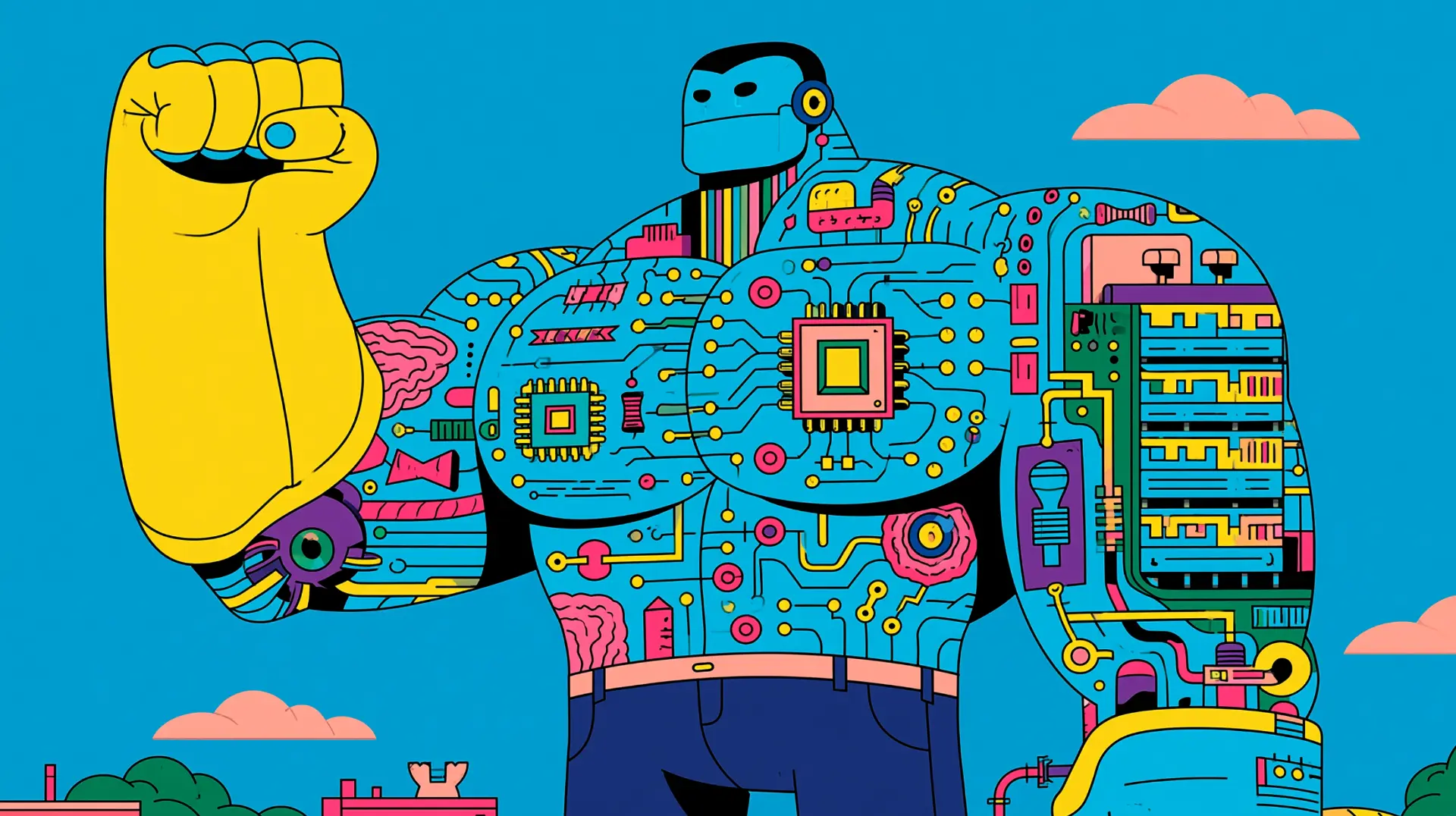
The revolution, in other words, isn't about brains. It's about brawn.
When most people open ChatGPT or a similar system, they see a clever assistant. A tool that can write emails, summarise documents, generate marketing copy or answer questions in a conversational way. And yes, that is useful. In many cases it is a genuine productivity boost. But it is also a very narrow way of thinking about what is, underneath the surface, a fundamentally different kind of capability.
Because AI is not simply responding to prompts in the way a human might. It takes a request and applies enormous computational resources to it in real time. It searches patterns across vast datasets, generates and evaluates possibilities at scale, and produces outputs that would previously have required entire teams of analysts working over days or weeks.
That distinction matters. For decades, that kind of computational power was the preserve of governments, research institutions, banks and large corporations. Supercomputers were expensive, specialised and rare. If you wanted to run large-scale simulations, process billions of data points or model complex systems, you needed infrastructure that cost millions and expertise that was equally scarce.
What has changed is not just that the technology exists, but that it is now accessible. In effect, something that resembles a supercomputer has been placed into the hands of almost every knowledge worker on the planet. The constraint is no longer access to computing power. It is our ability to imagine what to do with it.
Right now, most people still use these systems in relatively simple ways. They ask for a blog post, a summary, a set of bullet points or a rewritten email. These are all valid use cases, but they barely scratch the surface of what is possible. It is a bit like giving someone a high-performance engineering lab and watching them use it to fix a loose screw.
The more interesting applications are not about content generation at all. They are about analysis, simulation and transformation. Instead of asking AI to write a LinkedIn post, you could ask it to analyse fifty thousand customer interactions to identify patterns in churn. Instead of drafting a single strategy document, you could model multiple pricing scenarios across different market conditions. Instead of summarising a report, you could interrogate every report, contract and dataset an organisation has ever produced and surface insights that no individual or team would ever have the time to uncover.
This is where the idea of “brawn” becomes useful. What we are really talking about is not intelligence in the human sense, but scale. The ability to apply computational force to problems that were previously too large, too complex or too time-consuming to tackle properly.
In practical terms, it is the equivalent of giving every employee access to a team of analysts who never sleep, never get tired and can iterate through thousands of possibilities in seconds. Finance teams can stress-test entire business models. Sales teams can analyse every customer interaction across years of data. HR teams can identify long-term workforce trends that would otherwise remain invisible. Operations teams can optimise systems across variables that no human could realistically hold in their head at once.
None of this depends on AI becoming more intelligent in a human sense. It depends on us learning how to use the computational power that is already available to us.
History may well look back on this period not as the moment machines became intelligent, but as the moment humanity gained access to an unprecedented level of computational capability, a system for large-scale analysis and decision support, and simply did not know, at first, what to do with it.
The organisations that pull ahead over the next decade will be able to direct that computational power at the problems that actually matter.
The future of AI, then, is not just about building smarter machines. It is about finally learning how to use the extraordinary brawn as well as the brain.